





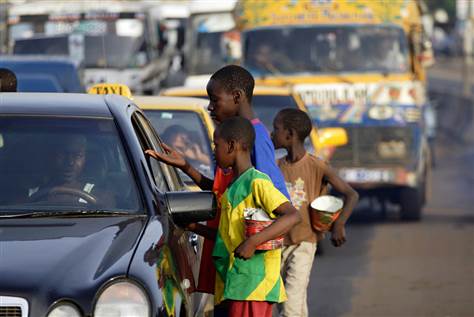
Begging is a problem that worries almost every country. Begging is an immemorial problem in Ghana which calls for the collective efforts of all persons to solve such issue. The issue of begging is an important subject to consider due to the rate at which children, disabled, and the vulnerable are abused, trafficked, and exposed to danger on the streets. Hence, this calls for the Government and the citizenry to give more attention to the issue of begging to safeguard the rights of children, disabled and the vulnerable.
Begging in Ghana is perceived by the public as a societal vice which interferes with the right of the public; it is perceived by the public as a nuisance sometimes due to the aggressive nature of beggars in seeking assistance. Some of the beggars are seen by the public as fraudsters who pretend to be ill or sick to make a living. One of the criticisms made by the public against the Government is the rate at which a huge number of children on the street are exposed to danger without any action or measures taken by the Government.
In a bid to ensure that beggars are integrated into the society and contribute their quota to the development of the nation, colonial, post – colonial, and current Governments have laid measures to reduce the rate of street begging in Ghana. First, the European Missionaries played an important role to ensure the protection of children. Their activities were mainly centered on children who were abandoned on streets to fend for themselves, the infirmed and the orphaned. 1Also, during the period of the Colonial rule, the focus of the Government on children and the vulnerable was based on residential care. 2There was an enactment of Children Care and Reformation Ordinance of 1928 (Ordinance No.12) which permitted the juvenile courts to deal with cases involving child delinquency and could also order for children neglected or abandoned on streets to be sent to children homes or other residential care or facilities. 3. In 1940, there was an establishment of the
Department of Social Welfare which was established for the care and industrial training of children abandoned and neglected. 4
Despite the measures put in place by the Colonial Government to reduce the rate of begging in Ghana, the Government developed an idea to employ a different alternative to reduce the menace of street begging. In 1954, the Gold Coast Government saw the need to establish a legal framework to tackle the issue of begging in Ghana. In 1954, the Gold Coast Government due to the increased rate of begging in Ghana inquired into poverty and begging. The report called “The Beggars Survey Of 1954”, revealed that there were 596 beggars in the country.5Some of these beggars were known to be professional beggars who begged for a living without suffering from any disability or sickness. 6 As a result, Governor Arden Clarke signed the Control of Beggars and Destitute Ordinance, 1957(ordinance No.36) in early March 1957 which was in force until repealed and replaced with Beggars and Destitute Decree, 1969 (NLCD 392).
The Decree was enacted on the 11th Day of September 1969 and came into force on the 19th of September 1969. The purpose of the decree is to criminalize the act of begging as well as provide for the reception and care of beggars and destitute.8 Hence, the law clearly states that the Minister must establish an institution for the reception and care of destitute.9 The import of this law is that the giver and the receiver commit the crime of begging once the proscribed act is committed and as such both would be held liable for a fine not exceeding one hundred and fifty penalties unit or a term of imprisonment not exceeding three months or both. The police and other law enforcement agencies upon the passage of this law are expected to ensure that any beggar found on the street is removed or arrested. However, the enactment of this law has not been able to serve the intended purpose. This is evidential from the program launched by the former Minister of Gender and Social
Protection called “Operation Get off The Street” on 2th May 2018. 10The program targeted to remove a huge number of children begging from the street. The Minister lamented that the rate of begging has not reduced because of the act of demand and supply by beggars and givers who believe it is their duty under religion or custom to give or receive alms. 11
Ensuing from this, there are certain gaps identified in the Decree which have to be addressed. First, the law fails to define what constitutes the act of begging in Ghana. Again, the rate of begging in Ghana may still increase as the law allows beggars and givers to receive or give alms in the name of religious custom or custom of the community. Also, the law is silent on what action must be taken in the best interest of a juvenile who is found begging on the street. One of the proposed measures to fill the gap is that the law must be certain of what constitutes the act of begging in Ghana. Also, some of the proposed solution made in this paper to reduce the rate of begging in Ghana is to decriminalize begging as a first step; establish permanent homes for the beggars and destitute; educate the public about the need for integration of beggars into the society and the creation of jobs and employment for these beggars.
The purpose of this chapter is to argue for the decriminalization of begging in Ghana as the first step for the integration of beggars into the society.
Download the full document here
By: SILAS OSEI BOATENG